
WASM By Hand - WAT Syntax (WebAssembly Text Format) - Part 02
Let's learn the basic WAT syntax

📍 You are here: Chapter 02 (Theory)
⏱️ Time to Complete: 25-30 minutes
📚 Prerequisites: Completed Chapter 01 (Introduction)
🎯 Learning Objectives:
Understand WAT module structure
Learn function syntax and parameter handling
Master stack-based operations with visual examples
Understand control flow (blocks, loops, if-else)
Learn memory operations (load/store)
Grasp import/export mechanisms
What is WAT?
WAT (WebAssembly Text Format) is the human-readable text representation of WebAssembly.
The compilation flow:
1. Write:    example.wat  (human-readable text)
2. Compile:  wat2wasm example.wat -o example.wasm
3. Run:      example.wasm (binary format)
Think of it like:
WAT = Assembly language (human-readable)
WASM = Machine code (binary)
wat2wasm = Assembler (converts text to binary)
Module Structure
Every WAT file is a module:
(module
  ;; Everything lives inside here
  ;; Semicolons start comments
)
A module can contain:
Functions
Memory
Imports
Exports
Global variables
Tables (for function references)
Functions
Basic Function Syntax
(func $name
  (param i32 i32)
  (result i32)
  ;; instructions here
)
Components:
$name- Optional function name (starts with$)(param type type ...)- Parameter types(result type)- Return type (optional, can be omitted for void)Instructions - Function body
Parameter Access
Parameters are accessed by index (0-based):
(func $add (param i32 i32) (result i32)
  local.get 0   ;; Get first parameter
  local.get 1   ;; Get second parameter
  i32.add       ;; Add them
)
Stack visualization:
Called with: add(5, 3)

Step 1: local.get 0
  Stack: [5]

Step 2: local.get 1
  Stack: [5, 3]

Step 3: i32.add
  Stack: [8]  ← Result
Named parameters (more readable):
(func $add (param $a i32) (param $b i32) (result i32)
  local.get $a
  local.get $b
  i32.add
)
💡 Best Practice: Always use named parameters for clarity!
Locals
Functions can have local variables (in addition to parameters):
(func $example
  (local i32)           ;; Anonymous local at index 0
  (local $sum i32)      ;; Named local

  i32.const 42
  local.set $sum        ;; Set local variable

  local.get $sum        ;; Get local variable
)
Important:
Locals are zero-initialized
Use
local.getto readUse
local.setto write
Control Flow (Structured)
WebAssembly uses structured control flow (no goto):
Block
(block $label
  ;; code
  br $label  ;; Break out of block
)
Loop
(loop $label
  ;; code
  br $label  ;; Continue loop (jump to start)
)
If-Else
(if (result i32)
  (i32.const 1)  ;; Condition (non-zero = true)
  (then
    i32.const 10
  )
  (else
    i32.const 20
  )
)
Branch Instructions
br $label- Unconditional branchbr_if $label- Branch if top of stack is non-zero
Linear Memory
WebAssembly has a flat byte array called linear memory:
(memory 1) ;; Allocate 1 page (64KB)Memory characteristics:
Grows in 64KB pages
Byte-addressable (like C arrays)
Shared between Wasm and host (JavaScript)
Memory Operations
Store (write):
i32.const 0      ;; Address
i32.const 42     ;; Value
i32.store        ;; Store value at address
Load (read):
i32.const 0      ;; Address
i32.load         ;; Load value from address
Different sizes:
i32.load8_u- Load 1 byte (unsigned)i32.load16_u- Load 2 bytes (unsigned)i32.store8- Store 1 bytei32.store16- Store 2 bytes
Imports & Exports
Exports
Make functions/memory available to the host:
(func $add (param i32 i32) (result i32)
  local.get 0
  local.get 1
  i32.add
)
(export “add” (func $add))
Shorthand:
(func (export “add”) (param i32 i32) (result i32)
  local.get 0
  local.get 1
  i32.add
)
Imports
Use functions provided by the host:
(import “env” “log” (func $log (param i32)))

(func (export “run”)
  i32.const 777
  call $log  ;; Call imported function
)
Import format: (import "namespace" "name" (func ...))
Common Instructions
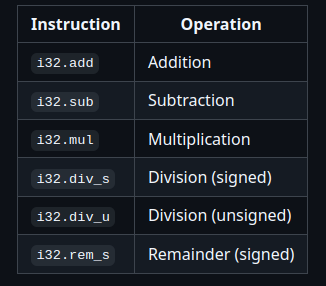
Arithmetic
i32.add,i32.sub,i32.mul,i32.div_s(signed),i32.div_u(unsigned)f32.add,f32.sub,f32.mul,f32.div
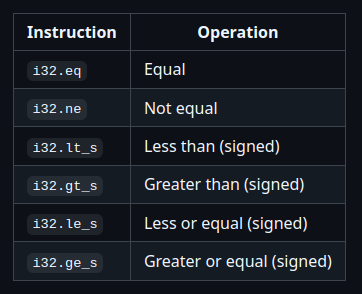
Comparison
i32.eq,i32.ne,i32.lt_s,i32.gt_s,i32.le_s,i32.ge_sSuffix
_s= signed,_u= unsigned
Logical
i32.and,i32.or,i32.xor
Constants
i32.const 42- Push constant to stackf32.const 3.14
Common Beginner Mistakes
❌ Mistake #1: Forgetting to Export Functions
Wrong:
(module
  (func $add (param i32 i32) (result i32)
    local.get 0
    local.get 1
    i32.add
  )
  ;; Missing export! JavaScript can’t call this function
)
Correct:
(module
  (func $add (param i32 i32) (result i32)
    local.get 0
    local.get 1
    i32.add
  )
  (export “add” (func $add))  ;; ✅ Now JavaScript can call it
)
❌ Mistake #2: Type Mismatches
Wrong:
i32.const 5
f32.add  ;; ERROR: Expected f32 on stack, got i32
Correct:
f32.const 5.0
f32.const 3.0
f32.add  ;; ✅ Both operands are f32
❌ Mistake #3: Stack Underflow
Wrong:
i32.add ;; ERROR: Need 2 values on stack, but stack is emptyCorrect:
i32.const 5
i32.const 3
i32.add  ;; ✅ Stack has 2 values
❌ Mistake #4: Wrong Memory Access
Wrong:
(module
  ;; No memory declared!
  (func (export “test”)
    i32.const 0
    i32.load  ;; ERROR: No memory to load from
  )
)
Correct:
(module
  (memory 1)  ;; ✅ Declare memory first
  (func (export “test”)
    i32.const 0
    i32.load
  )
)
❌ Mistake #5: Forgetting Return Values
Wrong:
(func $add (param i32 i32) (result i32)
  local.get 0
  local.get 1
  i32.add
  drop  ;; ERROR: Function promises i32 result, but stack is empty!
)
Correct:
(func $add (param i32 i32) (result i32)
  local.get 0
  local.get 1
  i32.add
  ;; ✅ Result stays on stack and is returned
)
Memory Layout Visualization
Understanding how data is laid out in linear memory:
Address:    0    1    2    3    4    5    6    7    8    9   10   11
          +----+----+----+----+----+----+----+----+----+----+----+----+
Bytes:    | 2A | 00 | 00 | 00 | FF | 00 | 00 | 00 | 48 | 65 | 6C | 6C |
          +----+----+----+----+----+----+----+----+----+----+----+----+
           |<-- i32 (42) -->|  |<-- i32 (255) ->|  |<-- "Hell" -->|

Explanation:
- Address 0-3:  i32 value 42 (little-endian: 0x0000002A)
- Address 4-7:  i32 value 255 (little-endian: 0x000000FF)
- Address 8-11: String "Hell" (ASCII bytes)
Little-endian: Least significant byte comes first
Value: 0x12345678
Memory: [78, 56, 34, 12]
         ^^  ^^  ^^  ^^
         LSB         MSB
Practice Exercises
Try writing these functions yourself:
Exercise 1: Multiply Function
Write a function that multiplies two i32 numbers.
Solution
(module
  (func (export “multiply”) (param $a i32) (param $b i32) (result i32)
    local.get $a
    local.get $b
    i32.mul
  )
)
Exercise 2: Max Function
Write a function that returns the larger of two i32 numbers.
HintUse `i32.gt_s` (greater than, signed) and `if` expression.Solution
(module
  (func (export “max”) (param $a i32) (param $b i32) (result i32)
    local.get $a
    local.get $b
    i32.gt_s
    (if (result i32)
      (then
        local.get $a
      )
      (else
        local.get $b
      )
    )
  )
)
Exercise 3: Store and Load
Write a function that stores a value at address 0 and then loads it back.
Solution
(module
  (memory 1)
  (func (export “storeAndLoad”) (param $value i32) (result i32)
    ;; Store value at address 0
    i32.const 0
    local.get $value
    i32.store

    ;; Load value from address 0
    i32.const 0
    i32.load
  )
)
WAT Syntax Cheat Sheet
Function Declaration
(func $name (param $p1 type) (result type)
  ;; body
)
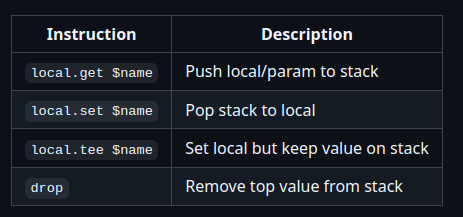
Stack Operations
Arithmetic (i32)
Comparison (i32)
Control Flow
(block $label
  ;; code
  br $label  ;; break
)

(loop $label
  ;; code
  br $label  ;; continue
)

(if (result type)
  (condition)
  (then
    ;; if true
  )
  (else
    ;; if false
  )
)
Memory
(memory 1)  ;; Declare 1 page (64KB)

i32.load    ;; Load 4 bytes
i32.load8_u ;; Load 1 byte (unsigned)
i32.store   ;; Store 4 bytes
i32.store8  ;; Store 1 byte
Learning Checkpoint
Test your understanding:
What does this code do?
i32.const 10
i32.const 5
i32.sub
AnswerPushes 10, pushes 5, subtracts (10 - 5 = 5). Result: 5 on stack.
What’s wrong with this code?
(func $test (result i32)
  i32.const 42
  drop
)
AnswerFunction declares it returns i32, but `drop` removes the value from stack. Stack is empty at function end, causing an error.
How do you access the second parameter?
(func $test (param $a i32) (param $b i32))Answer`local.get $b` or `local.get 1` (0-indexed)
What’s the difference between
brin a block vs a loop?AnswerIn a block, `br` breaks out (exits). In a loop, `br` continues (jumps to start).
How many bytes does
i32.storewrite to memory?Answer4 bytes (32 bits = 4 bytes)
✅ Chapter Summary
Key Takeaways:
WAT is human-readable - Compiles to binary
.wasmwithwat2wasmEverything is in a module - Functions, memory, imports, exports
Functions use stack-based execution - No registers, only stack operations
Structured control flow -
block,loop,if(nogoto)Linear memory is a flat byte array - Explicit load/store operations
No built-in strings - Must use memory + (pointer, length) pattern
Always export functions - Otherwise JavaScript can’t call them
Type safety is strict - Stack must have correct types for each instruction
🔜 Next Steps
You now understand WAT syntax! Next, let’s set up your development environment.
Continue to: Part 3: Setup
📚 Additional Resources
Previous: Part 1: Introduction
Previous: Part 1: Introduction
Next: Part 3: Setup